1. The work repeats and the variation is bounded
Repetition creates the economic case for automation, but repetition alone is not enough. A useful candidate has a recognizable beginning, a small number of common paths, and an output that the next person or system can act on.
Map ten recent examples before choosing the technology. If every example follows a completely different path, the immediate opportunity may be better process design rather than an AI build.
- A consistent trigger starts the work.
- Most cases follow a small set of paths.
- The expected output is specific and usable.
2. The system can reach the evidence
An AI workflow is only as useful as the context it can retrieve. Policies, tickets, documents, customer records, and system state need to be available at the moment a decision or draft is produced.
List every source, its owner, its freshness, and the access method. This exposes integration work early and prevents a polished prototype from hiding a missing data path.
3. A person owns the decision boundary
Decide what the system may retrieve, classify, draft, recommend, or write back. Then name the person accountable for exceptions and consequential actions.
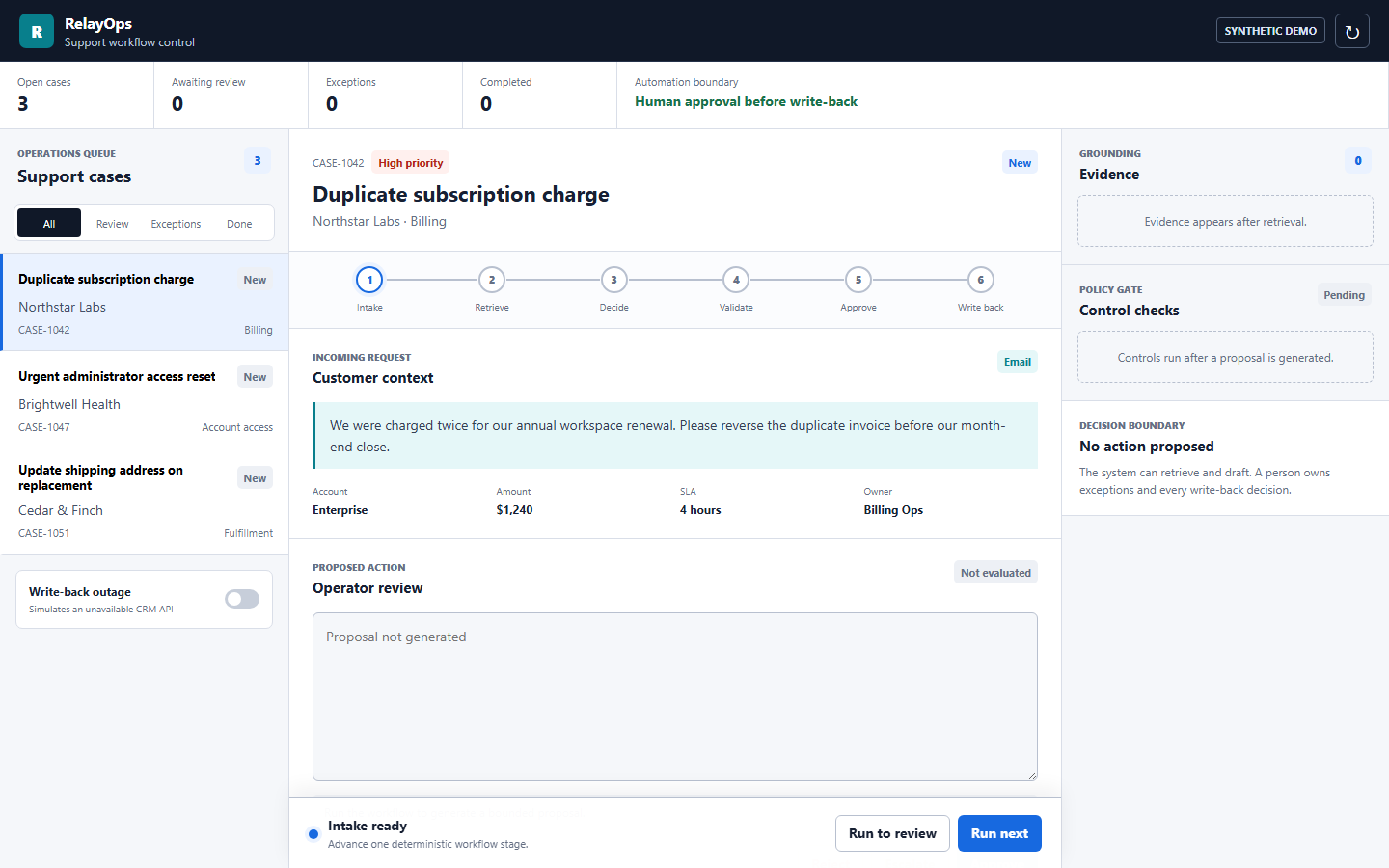
Human review works best as an explicit workflow state with evidence, a proposed action, and clear approve, revise, or escalate choices. A vague instruction to check the AI later is not a control.
4. The handoff is measurable
Capture the current cycle time, queue size, rework rate, response time, or number of manual touches before the build begins. Choose one primary measure and a small set of guardrails.
The first release should prove a better handoff, not merely produce a clever answer. That keeps the evaluation connected to the operation the business actually wants to improve.
5. The failure mode is acceptable
Every workflow needs a safe path for missing evidence, low confidence, integration failure, and unusual cases. The safest first candidate is one that can pause, route to a person, and recover without causing irreversible harm.
If the workflow passes all five checks, the next step is a short discovery sprint: document the current state, define the boundary, connect one evidence path, and test the complete handoff with representative cases.